I
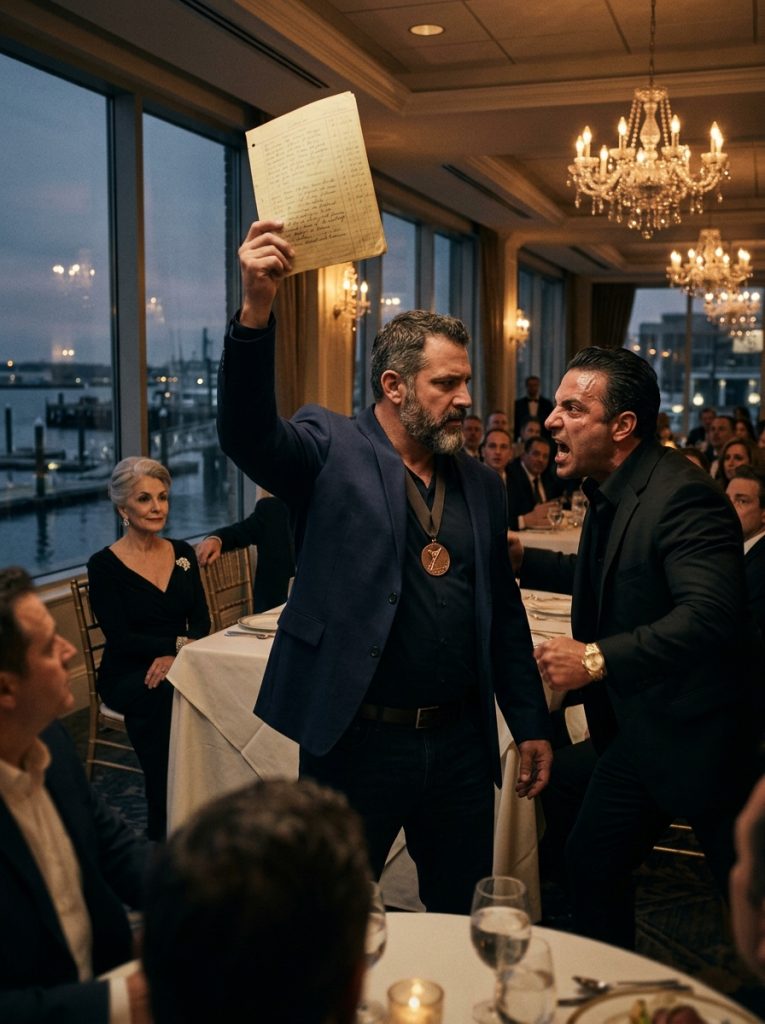
held the ledger page up to the chandelier light — deliberately, so every person in that ballroom could see the yellowed paper, the faded ink, the signature at the bottom.
Salvatore Vitale Jr.’s signature.
“This page,” I said, my voice carrying across the frozen room, “is from the Vitale Construction ledger dated March 12, 2019. It shows a wire transfer of exactly two million dollars — the amount I was accused of stealing — into an offshore account.”
I turned the page toward the crowd.
“The account belongs to Salvatore Vitale Jr.”
The ballroom erupted.
Voices overlapped. Chairs scraped. Someone dropped a champagne flute and it shattered against the marble floor like a punctuation mark.
Salvatore Jr. lunged toward me, his face purple. “That’s a forgery! He’s lying! The man is a disgraced thief and everyone here knows it!”
“Is it a forgery?” I asked calmly. “Then you won’t mind if I show the room the second page.”
I pulled another sheet from my jacket.
“This is the bank confirmation. Same date. Same amount. Same account number. Notarized. Stamped. Irrefutable.”
The room went quiet again — a different kind of quiet this time. Not shock. Judgment.
People were looking at Salvatore Jr. the way you look at a man whose house is on fire.
“You stole two million dollars from your own family’s project,” I said. “And you framed a working man to cover your tracks. You took my job. My reputation. My marriage. My home. You took five years of my life.”
I stepped closer to him.
“But you made one mistake. You didn’t burn every copy of the ledger. The old don — your uncle — he kept a backup. He suspected you for years. And when he died, he left instructions with his wife.”
I turned to Antonia Vitale.
She rose from her chair. Slowly. Deliberately. Every eye in the room followed her.
“My husband knew,” she said, her voice carrying the quiet authority of a woman who had been underestimated her entire life. “He knew his nephew was stealing from the family. He was gathering evidence when he died. And in his will — which I have held, unopened, for five years — he named Dominic Reyes as the executor of his personal estate.”
Salvatore Jr.’s voice cracked. “That’s a lie. That’s—”
“Security,” Antonia said, not raising her voice. “Please escort my nephew from the premises. The family will be filing criminal charges in the morning.”
Two men in dark suits appeared at Salvatore’s elbows. He struggled. He shouted. He threatened lawsuits and revenge and family loyalty — all the words of a man who had just realized he’d lost everything.
The crowd watched him go.
Then Antonia turned to me.
“Dominic,” she said softly. “My husband always believed in you. I’m sorry it took five years to prove it.”
She unpinned the diamond brooch from her gown and pressed it into my hand.
“This was his mother’s. He wanted you to have something of the family — because you were always more family to him than his own blood.”
I stood in that ballroom, the medal on my chest, the brooch in my hand, the murmur of a hundred guests washing over me like absolution.
The waterfront contract was transferred to my company the next morning. Salvatore Jr. was indicted within a week. And the construction firm that had refused to hire me for five years suddenly found my number.
I didn’t call them back.
I was too busy rebuilding — this time, with the full weight of the Vitale name behind me, and the blessing of a widow who never stopped believing in the truth.