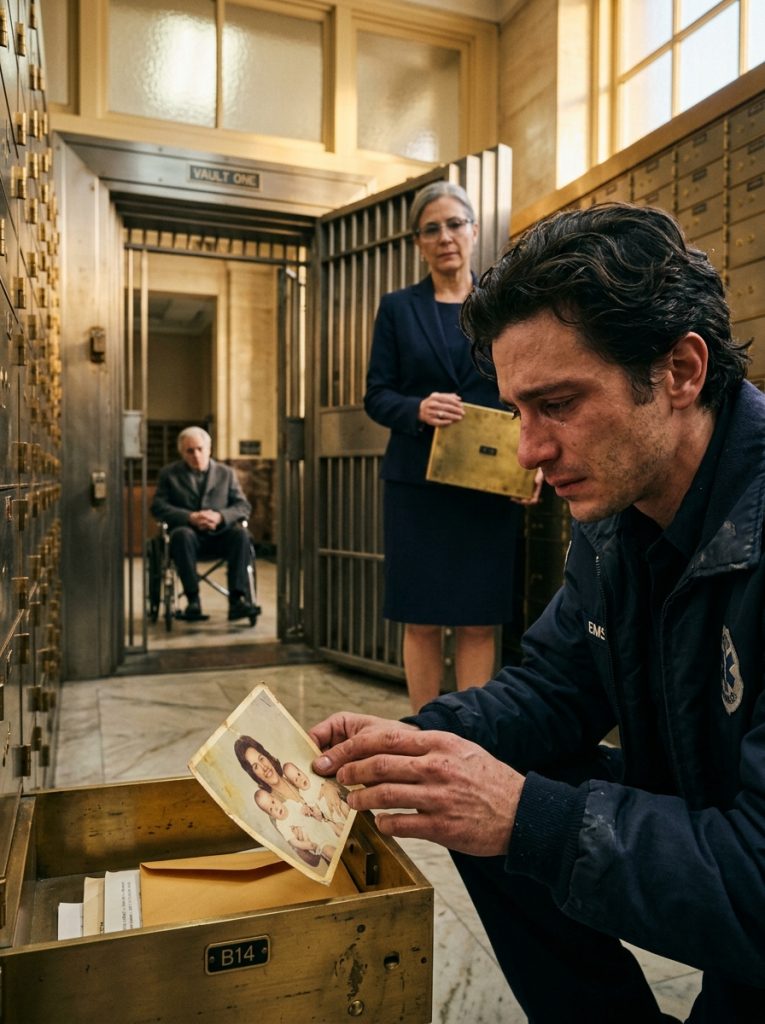
Gianna Russo led me through the bank lobby to a quiet office where the blinds were already drawn.
“Sit down, Mr. DeMarco. This will take some time.”
I sat. I was still holding the photograph — my birth mother holding two infants, one of them me. My hands hadn’t stopped trembling since the vault.
“The man in the wheelchair outside,” I said. “Vincent DeMarco. He’s my father?”
“He is. And he’s been watching over you your entire life.”
The story she told me took an hour. The rival family — not the Morettis, but a splinter faction that had been absorbed years ago — had put a hit on Vincent DeMarco’s newborn heir in 1998. A nurse in the maternity ward was paid to switch the babies. My twin brother, Lucien, was left in the hospital bassinet. I was taken — handed to a contact who was supposed to deliver me to the rival don.
But the contact had a conscience. Instead of delivering me, he left me in the lobby of a Philadelphia fire station with a note that said only: “His name is Leo.”
“Vincent spent twenty years searching for you,” Gianna said. “He found you when you were eight, in a foster home in North Philly. But by then, the rival family was still active. If he’d brought you home, they would have killed you — and likely your brother too. So he made a choice that broke his heart.”
“He stayed away.”
“He stayed away. But he made sure your foster care was funded. Your medical bills were paid. Your college scholarship — that wasn’t a scholarship. That was him.”
I stared at her. “I worked as a paramedic for six years. I lived in a studio apartment. I ate ramen three nights a week. He could have—”
“He could have exposed you. Every time he got close, the rival family’s informants picked up the scent. He chose your safety over his own need to know you.”
The door opened.
Vincent DeMarco wheeled himself in.
Up close, I could see the resemblance. The shape of the jaw. The set of the eyes. This man — this former don who had controlled half of Philadelphia’s waterfront — was my father.
“Leo,” he said. His voice was rough, worn down by age and grief. “I know you have questions. I know you’re angry. You have every right to be.”
“Angry?” I said. “I grew up believing I was abandoned. Every birthday, every Christmas, every time a foster parent looked at me like I was damaged goods — I thought my real parents just didn’t want me.”
“I wanted you every single day.”
His eyes filled. The notorious Vincent DeMarco — the man who had faced down federal indictments and rival assassins — was crying.
“I have a brother,” I said.
“Lucien. He grew up believing he was the sole heir. He doesn’t know about you yet.”
“Doesn’t know?”
“I wanted you to decide. If you want to meet him, I’ll arrange it. If you want nothing to do with this family, I’ll understand. I’ve been protecting you from a distance for twenty-eight years. I can keep doing it.”
I looked at the photograph. At the woman who was my mother. At the two babies in her arms.
“I want to meet him,” I said.
Lucien arrived an hour later. He was my height. My build. The same wavy dark hair. He walked into that bank office looking like a man who’d just learned his entire identity was built on a half-truth.
We stared at each other for a long moment.
Then he said: “So you’re the reason Dad never let me win at Monopoly. He was saving the championship for you.”
I laughed. I couldn’t help it.
And in that laugh, twenty-eight years of loneliness — of wondering who I was, where I came from, whether anyone had ever wanted me — began to dissolve.
The DeMarco empire would have complications. Lucien had been raised to inherit. I had no interest in organized crime. But Vincent — with the last months of his life — had one request.
“Just be brothers,” he said. “That’s all I ever wanted.”
I’m still a paramedic. I still work the night shift. But now, twice a week, I have dinner at a row house in the Italian Market with a twin brother I never knew existed — and a father who spent twenty-eight years loving me from the shadows.