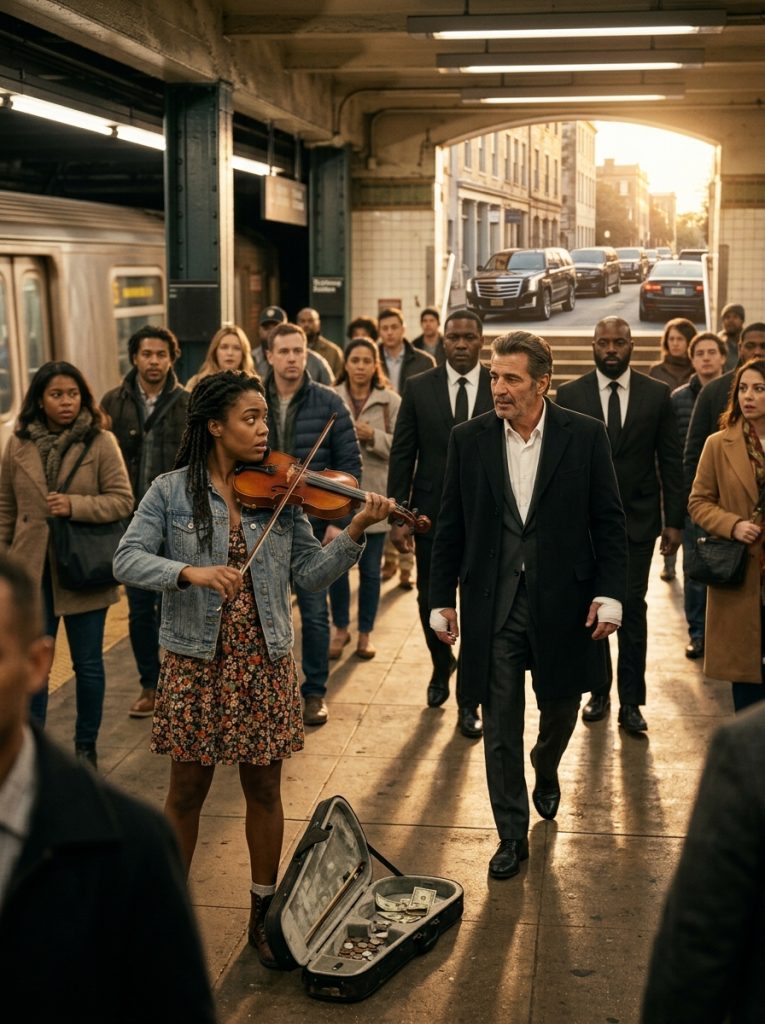
Tessa Barnes took the black card.
The commuters on the Charleston subway platform had stopped moving. Every face was turned toward her — the busker with the violin case, the girl in the thrift-store dress, the woman who had just been handed a card by a man surrounded by black-suited security.
Matteo Corvino didn’t leave immediately. He stood in front of her, his bandaged right hand lowered now, his weathered face open in a way that suggested vulnerability was a rare and uncomfortable state for him.
“I need to explain,” he said.
“You don’t owe me an explanation.”
“I owe you everything.”
Tessa tucked her violin under her arm. The bow — her good one, the one she’d bought to replace the broken one she’d used to splint his hand — hung from her fingers.
“That night in the alley,” Matteo said, “I wasn’t supposed to survive. A rival crew had caught me alone. No guards. No backup. They left me in that alley expecting me to bleed out before anyone found me.”
“But I found you.”
“You found me. And you didn’t call the police first — you called an ambulance. You didn’t run. You didn’t take my wallet, my watch, my phone. You took off your grandmother’s scarf and wrapped my hand. And when the paramedics asked who you were, you just gave them your name and left.”
Tessa remembered. The paramedics had been confused — why was a woman in a floral dress kneeling in an alley with a man in a ruined suit? She’d just said, “He needed help,” and walked away.
“I had people looking for you for three weeks,” Matteo continued. “Every hospital record. Every police report. But you hadn’t left a number. You hadn’t given a last name to anyone. My people finally found you through the tea room — the manager remembered you’d played a set that night.”
“You’ve been looking for me for three weeks?”
“I’ve been looking for the woman who saved my life with a broken violin bow.”
He gestured toward the black card in her hand.
“That number connects to my private line. Twenty-four hours a day. If you ever need anything — money, protection, a door opened that won’t open for you — you call that number. No questions. No conditions. No debt.”
Tessa looked at the card. Then at the fleet of black cars visible through the station entrance. Then at the commuters who had walked past her violin case every day for two years without ever meeting her eyes, now frozen mid-step, phones raised, recording.
“Mr. Corvino — “
“Matteo.”
“Matteo. I don’t need money. I don’t need protection. I’m a busker. I play violin. I make enough to pay my rent and buy my groceries. I’m not looking for a reward.”
“I know. That’s why I’m offering one.”
He took a step closer. His voice dropped — not to a whisper, but to something more intimate. Something meant only for her.
“Do you know how rare it is, in my world, to meet someone who helps a stranger without calculating what they can get in return? Every person I’ve ever met has wanted something from me. Power. Money. Protection. You wanted nothing. You didn’t even know my name.”
“My grandmother always said kindness isn’t a transaction.”
“Your grandmother was a wise woman.”
Tessa smiled. A small one. The kind that remembers.
“She died two years ago. I play her violin. Every note I play is for her.”
Matteo looked at the violin in her hands — the worn wood, the careful polish, the love that kept an old instrument alive.
“Then play for me sometime. Not for payment. Not because you owe me. Just because I’d like to hear the music that comes from the woman who saved my life.”
Tessa tucked the black card into her violin case. She didn’t know if she’d ever use it. She didn’t know if she wanted to be connected to a world of black cars and dark suits and men who got left bleeding in alleys.
But she knew one thing.
The man she’d helped without asking for anything — the man whose name she’d never learned — had spent three weeks searching for her just to say thank you.
“Friday night,” she said. “The tea room. Eight o’clock. I’ll play for you.”
Matteo Corvino — the untouchable don of the Eastern seaboard — nodded once. And for the first time in what looked like years, he smiled.
“I’ll be there.”
The fleet of black cars pulled away. The commuters slowly returned to their lives. And Tessa Barnes placed her violin under her chin and started playing — not for tips, not for tourists, but for herself. For her grandmother. For the simple, radical idea that kindness was never meant to be a transaction.
It was just meant to be given.
And sometimes, if you were lucky, it came back.