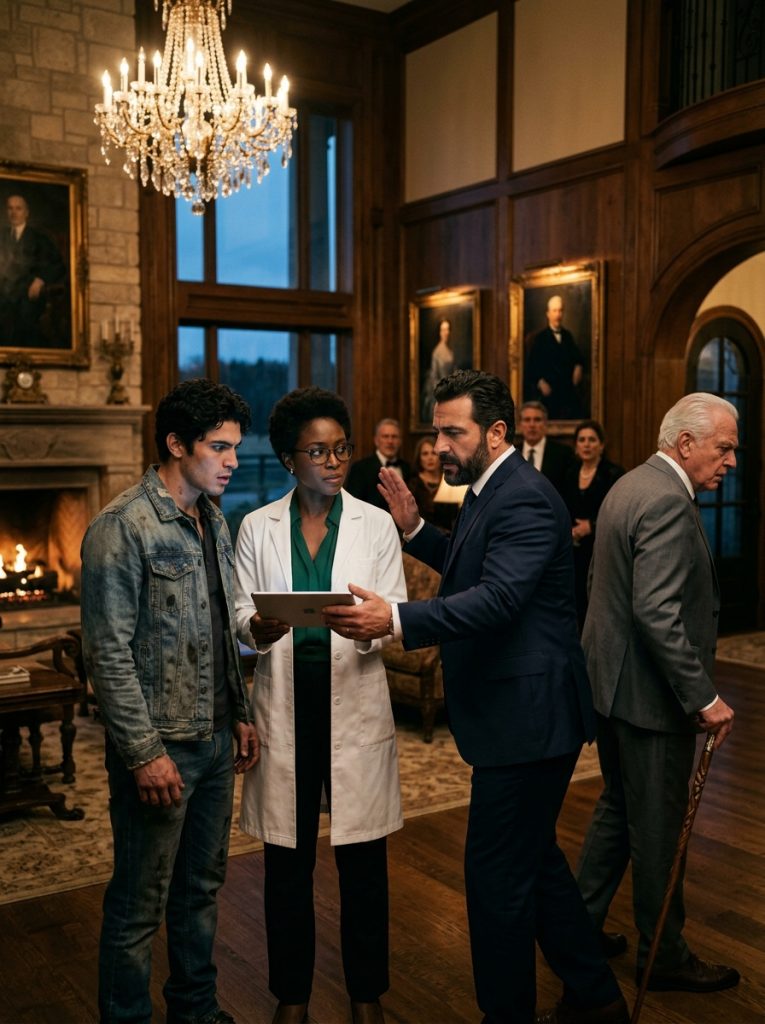
The Vitale family gathered in the grand living room of their Dallas estate as they had every year for the past four decades. Family portraits lined the walls — generations of Vitales staring down from gilded frames. Chandeliers. Persian rugs. Tall windows overlooking the Texas ranch that had been in the family since before Texas was a state.
But tonight, the family wasn’t gathering to celebrate.
They were gathering to face a truth that had been buried for twenty-three years.
Dr. Amara Osei walked through the front doors with Mateo Herrera beside her. The oil-stained mechanic in the worn denim jacket looked wildly out of place among the tailored suits and designer gowns — but his face belonged here. The same sharp jaw. The same dark eyes. The same features that stared down from every portrait on every wall.
Eduardo Vitale, the seventy-four-year-old patriarch, stood at the head of the room. Silver hair. Grey suit. Walking stick gripped in a white-knuckled hand. He had been expecting this confrontation. Amara’s phone calls had made sure of that.
“This is an insult,” Eduardo said. “You bring a stranger into my home and expect—”
“He’s not a stranger.” Alessandro Vitale stepped forward. “He’s your grandson.”
A collective gasp moved through the room.
Amara raised her tablet. The DNA results glowed on the screen. “Mateo Herrera shares 99.8% of his genetic markers with the Vitale family line. Specifically, he is the biological son of Rosa Herrera and — ” she paused ” — Alessandro Vitale.”
The silence that followed was absolute.
Alessandro didn’t flinch. He had known this was coming. He had been waiting for someone to find out.
“Twenty-three years ago,” Alessandro said, “I fell in love with a woman my father disapproved of. Rosa Herrera was the daughter of a ranch hand. My father told me she was beneath the Vitale name. He threatened to disown me if I married her.”
Eduardo’s face twisted. “You were young. You didn’t understand—”
“I understood perfectly,” Alessandro cut him off. “You paid a doctor to declare Rosa dead after the car accident. You had my son — your grandson — taken by child protective services within forty-eight hours of his birth. You forged the paperwork yourself. And then you told me Rosa had died and the baby with her.”
“You told him what?” Mateo’s voice was barely a whisper.
Alessandro turned toward his son. His son. The words were still impossible.
“I didn’t know you existed until seven years ago. I found a monthly wire transfer — $5,000 — that my father’s financial officer had been sending to a woman named Rosa Herrera for years. I investigated. I found out she was alive. That she had given birth. That you had been placed in foster care. I’ve been sending that money every month since.”
“You’ve been sending money,” Mateo said. “But you never came to find me.”
Alessandro’s face broke. “I was a coward. I told myself I was protecting you — keeping you away from this family, this life. But the truth is, I was afraid. Afraid of what you would think of me. Afraid of my father. Afraid of admitting that I’d let my own son be stolen without fighting hard enough to find him.”
Mateo stared at him.
Then at Eduardo — the grandfather who had erased his existence with a pen stroke.
Then at Amara — the hematologist who had refused to let a “clerical error” stay buried.
“Twenty-three years,” Mateo said quietly. “I grew up in seven different foster homes. I worked on ranches because it was the only thing I was ever good at. I had no family. No history. No name. And this whole time — you were here. In this house. With these portraits. With my face on your walls.”
Eduardo struck his walking stick against the floor. “I did what was necessary to protect this family’s legacy!”
“You destroyed your own family’s legacy,” Alessandro said. “You destroyed my son. You destroyed Rosa. And you destroyed any chance of me ever forgiving you.”
Mateo walked toward Eduardo. The old man stiffened, expecting anger. Violence. Revenge.
Instead, Mateo stopped two feet away and simply looked at him.
“I don’t want your money. I don’t want your name. I just wanted to know where I came from. And now I know.”
He turned toward Alessandro. “You — I don’t know yet. Twenty-three years is a long time. But you sent that money every month. You didn’t forget. That counts for something.”
Alessandro’s eyes were wet. “I’ll spend the rest of my life proving it counts for more than something.”
Amara closed her tablet. Her work here was done. The bloodline everyone denied was proven. The misunderstanding that split a family had finally broken open.
Eduardo Vitale turned and walked out of his own living room — the patriarch who had ruled this family for forty years, now walking away from the grandson he tried to erase.
But Mateo didn’t watch him go.
He was looking at the portraits on the walls. His face. His jaw. His eyes. Staring back at him from every frame.
He had finally come home.